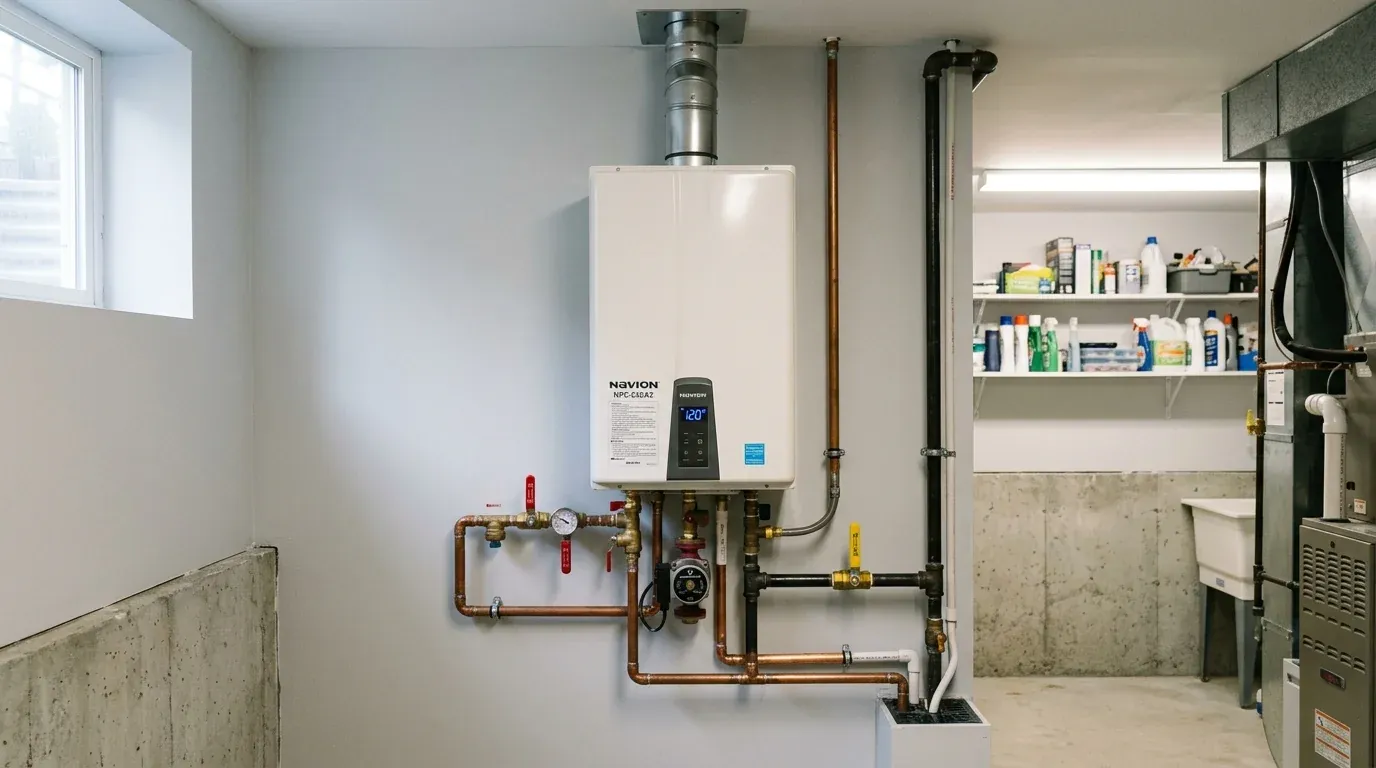
On-demand tankless water heaters deliver endless hot water through high-efficiency copper heat exchangers, but hard water minerals and restricted gas flow cause operational shutdowns. Narrow heat exchanger passages accumulate calcified scale, triggering flow restriction error codes and sudden water temperature fluctuations. Experienced plumbing technicians connect utility pumps to service isolation valves to circulate virgin descaling solutions that dissolve baked-on mineral deposits. Technicians clean intake air filters, examine exhaust venting for backdrafting, test flame ionization rods, and verify that gas supply lines provide adequate volume under peak firing demand. Proper maintenance protects expensive heat exchangers, eliminates 'cold water sandwich' cycles, and ensures your tankless unit operates at peak energy efficiency.
Core Procedures & Diagnostics
Exchanger Descaling
Circulating food-grade descaling solution through service valves to dissolve copper scale.
Error Code Diagnostics
Interpreting manufacturer fault codes to isolate sensor failures and ignition lockouts.
Gas Volume Testing
Measuring inlet dynamic gas pressure with a digital manometer under maximum firing load.
Sensor Servicing
Cleaning flame rectification sensors and water flow turbines to restore steady ignition.
Frequently Asked Questions About Tankless Water Heater Installation & Repair
Manufacturer diagnostic codes pinpoint specific mechanical faults like ignition failure, exhaust blockages, or scale buildup. Technicians reference technical service manuals, test sensor circuits, and clear lockouts once the underlying malfunction is corrected.
Mineral scale encrusting the heat exchanger or a sticking water flow sensor disrupts continuous burner modulation. Low shower flow rates below the minimum ignition threshold can also cause burners to shut down mid-shower. Descaling the exchanger and adjusting flow parameters resolves the temperature drop.
Annual descaling is recommended for households supplied by municipal water containing moderate to high mineral hardness. Skipping annual flushing allows calcium deposits to bake onto copper walls, eventually causing thermal stress cracks that void manufacturer warranties.
Tankless gas units require between 150,000 and 199,000 BTUs instantaneously, demanding larger gas lines than traditional storage tanks. Undersized piping starves the burner during cold weather, causing flame loss and error codes. Plumbers verify pipe sizing and install dedicated gas runs.
Restricted combustion intake airflow or heavy mineral scaling inside narrow copper passages creates high-pitched whistling. Cleaning the fan intake blower and circulating descaling acid opens the passageways, restoring quiet operation.
Most manufacturers explicitly exclude heat exchanger ruptures caused by lime scale buildup from warranty coverage. Performing documented annual descaling with isolation service valves preserves warranty protection and equipment longevity.
Bathroom faucets with low-flow aerators often fail to reach the 0.5 gallon-per-minute minimum activation threshold required by the flow turbine. Cleaning faucet aerators or adjusting the unit activation sensitivity allows the burner to fire on low flow demands.
Well-maintained tankless systems routinely operate for fifteen to twenty years, roughly double the service life of traditional storage tanks. Replacing consumable parts like flame sensors, igniters, and water valves keeps the core unit functioning smoothly.
Book Tankless Water Heater Installation & Repair
Speak with our dispatch team to check local technician availability and get an upfront price estimate.